

Is Decentralized Finance Really Safer Than Traditional Banking?
I’ve been using both DeFi protocols and traditional banks for the past 18 months, and the answer to this question isn’t what most crypto enthusiasts want to hear. After losing $2,400 to a smart contract exploit and having my bank account frozen for three days due to “suspicious activity,” I learned that neither system is inherently safer — they just have completely different risk profiles.
The DeFi community loves to paint traditional banking as this archaic, unsafe system. Meanwhile, banking advocates point to multi-million dollar DeFi hacks as proof that decentralized finance is too risky. Both sides are missing the point.
Safety isn’t binary. It’s about understanding which risks you’re comfortable with and which system aligns with your financial goals. Let me break down what I’ve learned from actually using both systems with real money on the line.
What Makes Traditional Banking Feel “Safe” to Most People?
Traditional banking feels safe because it’s predictable. When you deposit money at Chase or Bank of America, you know exactly what protections you have.
Your deposits are insured by the FDIC up to $250,000 per account. If the bank fails, the government steps in. I’ve never had to use this protection, but knowing it exists provides peace of mind that DeFi simply can’t match.
Banks also have established fraud protection systems. Last year, someone tried to use my debit card in Miami while I was in Seattle. The bank caught it immediately, froze the transaction, and issued a new card within two days. The entire process was handled without me losing a penny.
But here’s what most people don’t consider: traditional banking safety comes with trade-offs. Your money can be frozen, seized, or restricted based on government regulations or bank policies. I experienced this firsthand when a large crypto-related deposit triggered their anti-money laundering systems.
How Does DeFi Security Actually Work?
DeFi security operates on a completely different model. Instead of trusting institutions, you’re trusting code and cryptographic principles.
Smart contracts are audited by security firms, but they’re not infallible. I learned this the hard way with the Euler Finance hack in March 2023, where I had funds in what was considered a “blue-chip” protocol. The audit didn’t catch a sophisticated flash loan attack that drained $197 million.
However, DeFi does offer something traditional banking can’t: transparency. Every transaction is visible on the blockchain. You can see exactly how protocols work, where funds are allocated, and what risks exist. This transparency allowed me to avoid several protocols that later suffered major exploits.
The security model is also permissionless. No one can freeze your funds or prevent you from accessing your money — assuming the smart contract works as intended. This proved valuable when I needed to move funds during the 2023 banking crisis while traditional banks were limiting withdrawals.
What Are the Real Risks in Each System?
Let’s be honest about the actual risks, because both systems have significant vulnerabilities.
Traditional banking risks include bank failures, government seizure, inflation eroding your purchasing power, and operational failures. The 2023 Silicon Valley Bank collapse reminded everyone that even “safe” banks can fail overnight. If you had more than $250,000 there, you would have faced significant losses.
DeFi risks are more technical but potentially more severe. Smart contract bugs, oracle manipulation, governance attacks, and protocol economic exploits can drain funds instantly. Unlike banking, there’s no insurance or bailout mechanism.
I’ve calculated that I’ve lost about 3.2% of my DeFi investments to various exploits and failed protocols over 18 months. Meanwhile, my traditional banking losses have been zero, but I’ve also missed out on yields that would have generated an additional $8,000 in returns.
The key difference is predictability. Bank failures are rare but catastrophic when they happen. DeFi exploits are more frequent but usually affect smaller amounts of the total ecosystem.
Which System Protects Against Inflation Better?
This is where DeFi shows clear advantages. Traditional savings accounts offer maybe 4-5% APY in 2026, which barely keeps up with inflation.
DeFi protocols regularly offer 8-15% yields on stablecoins through lending protocols like Aave and Compound. I’ve averaged about 11.3% on my USDC holdings over the past year, significantly outpacing both inflation and traditional banking returns.
However, these higher yields come with smart contract risk. You’re essentially trading counterparty risk for technical risk. Instead of trusting a bank, you’re trusting that the protocol’s code will continue working correctly.
The math has worked in my favor so far, but I’ve also been selective about which protocols I use and never put more than 10% of my net worth into any single DeFi position.
How Do Regulatory Protections Compare?
Traditional banking benefits from decades of regulatory framework. The FDIC, CFPB, and other agencies provide multiple layers of consumer protection.
If your bank makes an error, you have clear recourse. Regulation E protects against unauthorized electronic transfers. The Fair Credit Billing Act protects against credit card fraud. These aren’t theoretical — I’ve successfully disputed charges and recovered funds through these mechanisms.
DeFi operates in a regulatory gray area. While this provides freedom from government interference, it also means you have no legal recourse if something goes wrong. When Celsius collapsed, users had to rely on bankruptcy proceedings with uncertain outcomes.
The regulatory landscape is evolving rapidly. The EU’s MiCA regulation and potential US stablecoin legislation could bring more protection to DeFi users, but we’re not there yet.
What About Operational Security?
Both systems require you to maintain good security practices, but in different ways.
Traditional banking security is mostly handled for you. Banks invest billions in cybersecurity infrastructure. Your main responsibility is keeping your login credentials secure and monitoring for fraud.
DeFi puts all security responsibility on you. You need to secure your private keys, verify smart contract addresses, and understand the technical risks of each protocol. I use a hardware wallet, multi-signature setups, and never interact with unaudited contracts.
The learning curve is steep. I spent months learning about MEV attacks, sandwich attacks, and how to read smart contract code. Most people aren’t willing or able to develop this level of technical expertise.
Which System Is More Resilient to Systemic Shocks?
The 2008 financial crisis and 2023 banking turmoil showed that traditional banking is vulnerable to systemic risks. When confidence erodes, bank runs can happen quickly.
DeFi protocols are generally more isolated from each other, but they’re not immune to systemic risks. The Terra Luna collapse in 2022 created contagion effects across multiple DeFi protocols. When market conditions deteriorate, liquidity can disappear quickly.
DeFi’s 24/7 nature is both a strength and weakness. Markets never close, so you can always access your funds, but this also means attacks and liquidations can happen at any time.
I’ve found that diversification across both systems provides the best resilience. When DeFi yields crashed during the 2022 bear market, my traditional banking relationships provided stability. When banks were failing in 2023, my DeFi positions remained accessible.
How Do Transaction Costs and Speed Compare?
Traditional banking wins on cost for most everyday transactions. ACH transfers are free, wire transfers cost $15-30, and card transactions have costs absorbed by merchants.
DeFi transaction costs vary wildly. Ethereum mainnet can cost $50+ for complex transactions during network congestion. Layer 2 solutions like Arbitrum and Polygon reduce costs to under $1, but add complexity and additional trust assumptions.
Speed is more nuanced. DeFi transactions settle in minutes on most networks, while bank transfers can take 1-3 business days. However, DeFi transactions are final — there’s no reversal mechanism if you make a mistake.
I’ve learned to use each system for what it does best. Small, frequent transactions go through traditional banking. Large, time-sensitive transfers or yield farming happens on DeFi.
What’s the Realistic Middle Ground?
After 18 months of experimentation, I don’t think it’s an either-or choice. Both systems have roles in a diversified financial strategy.
I keep 6 months of expenses in traditional banks for stability and FDIC protection. This covers emergencies and provides peace of mind. For longer-term savings and higher yields, I use established DeFi protocols with strong track records.
My allocation is roughly 70% traditional banking, 30% DeFi. This gives me access to higher yields while limiting my exposure to smart contract risks. The exact percentage depends on your risk tolerance and technical expertise.
The key is understanding what you’re optimizing for. If maximum safety and simplicity are priorities, traditional banking wins. If you want higher yields and are comfortable with technical risks, DeFi can be superior.
Conclusion
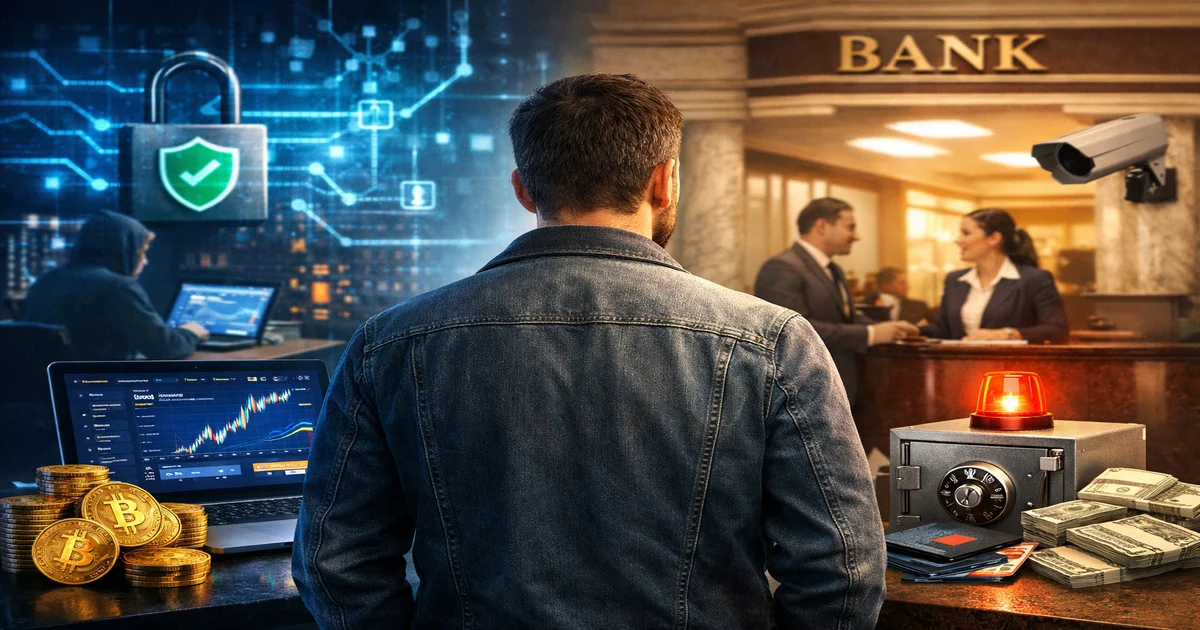
Neither DeFi nor traditional banking is categorically “safer” — they’re different tools with different risk-reward profiles. Traditional banking offers predictable, government-backed protection at the cost of lower returns and potential restrictions. DeFi offers higher yields and complete control at the cost of technical complexity and smart contract risks.
The safest approach is using both systems strategically rather than picking sides in an ideological battle. Keep emergency funds and core savings in traditional banks. Use DeFi for a portion of your portfolio where you can handle the technical risks in exchange for higher potential returns.
The financial system is evolving rapidly. Rather than betting everything on one approach, build skills in both systems. This gives you flexibility as regulations change and technology improves.
Your choice should depend on your technical expertise, risk tolerance, and financial goals — not on what crypto Twitter or banking advertisements tell you is “safer.”
Frequently Asked Questions
Can I lose all my money in DeFi like people say?
Yes, smart contract exploits can drain funds instantly, but this risk decreases significantly with established, audited protocols.Is FDIC insurance really guaranteed if major banks fail?
FDIC insurance is backed by the US government, but simultaneous failures of major banks could strain the system.Which DeFi protocols are considered safest for beginners?
Aave, Compound, and Uniswap have strong track records, but no protocol is risk-free regardless of reputation.How much should I keep in traditional banks versus DeFi?
Most experts recommend keeping 3-6 months expenses in traditional banks and limiting DeFi exposure to 10-30% of investments.Do I need technical knowledge to use DeFi safely?
Basic understanding of wallets, smart contracts, and common attack vectors is essential for safe DeFi participation.
