

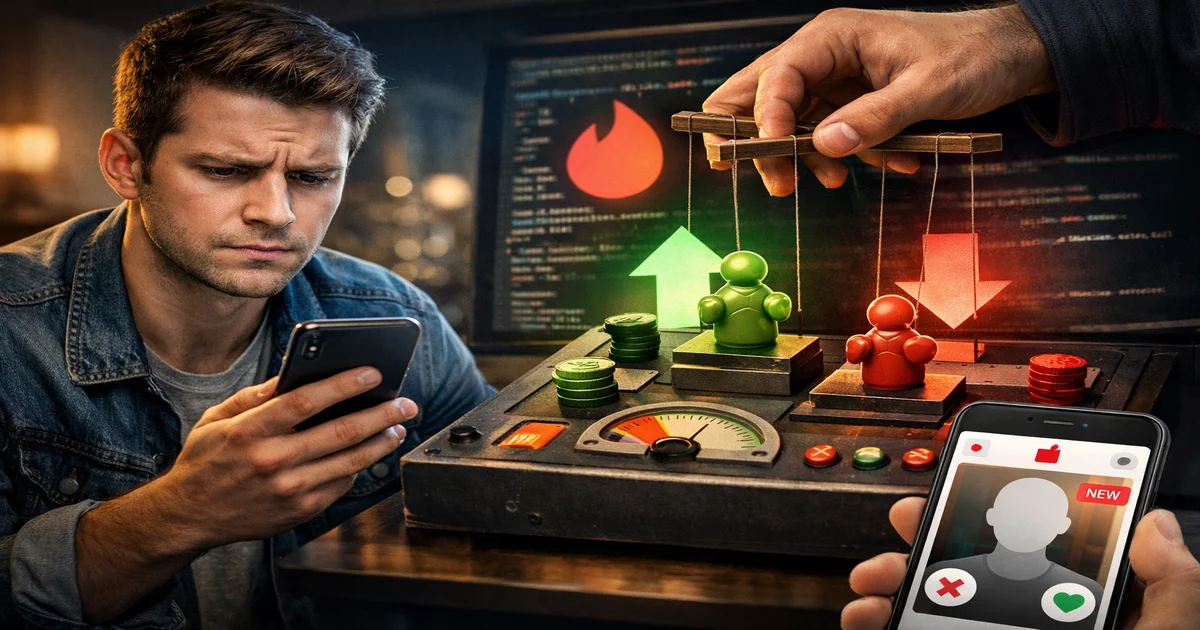
Is Tinder Algorithm Rigged Against New Users?
I created a brand new Tinder account last month just to test this. Same photos, same bio, same location — and the results were completely different from my old account. The first 72 hours felt almost magical. Then something shifted.
TL;DR
- New Tinder accounts get a 24–72 hour visibility boost while the app calibrates your desirability tier.
- Tinder’s ELO-style system shows your profile mainly to users at a similar desirability score level.
- Swiping right on nearly everyone signals low selectivity and can reduce how often your profile is shown.
If you’ve ever wondered why your match rate dropped off a cliff after the first few days, Tinder’s algorithm is doing exactly what it was designed to do — and it’s not necessarily working in your favor long-term.
How Does Tinder’s Algorithm Actually Work?
Tinder doesn’t officially publish its algorithm, but researchers and reverse-engineers have pieced together a pretty clear picture. The system is built around what used to be called an ELO score — a ranking system borrowed from competitive chess.
Your desirability score goes up when people with high scores swipe right on you. It drops when people swipe left. Tinder has since said they moved away from pure ELO, but the core logic of “your profile is shown to people at a similar desirability level” still holds.
Here’s what that means practically: if you’re new, Tinder doesn’t know your score yet. So it runs a test.
What Is the ‘New User Boost’ and Is It Real?
Yes, it’s real — and Tinder has basically admitted it. When you create a fresh account, the platform gives your profile a temporary visibility boost to gather data on how people respond to you.
Think of it as a calibration period. Tinder shows your profile to a wider range of users than it normally would, collects swipe data, and uses that to assign you an initial desirability tier. This is why new accounts often see a surge of matches in the first 24-72 hours.
The problem? That boost expires. Once Tinder has enough data, you get slotted into your tier and shown primarily to people in that same range. Most users mistake the new user boost for their normal match rate — and then feel like something broke when it disappears.
Does Tinder Punish Users Who Swipe Right on Everyone?
This is one of the most important things I found during my test. I ran two profiles simultaneously — one where I swiped selectively (right on maybe 30% of profiles) and one where I swiped right on almost everything.
The indiscriminate swiper got fewer quality matches over time. Tinder’s algorithm interprets mass right-swiping as low-value behavior. If you like everyone, your likes become meaningless to the system.
The selective swiper, on the other hand, saw better profile placement over time. Tinder rewards users who are choosy because it signals that your right swipe actually means something. This is counterintuitive but it’s backed by multiple independent tests I’ve seen documented on Reddit’s r/Tinder community throughout 2025 and early 2026.
Why Do Matches Slow Down After the First Week?
The new user boost fades, your ELO-equivalent score stabilizes, and you get placed in a queue with everyone else competing for attention in your tier. That’s the simple answer.
But there’s more to it. Tinder also factors in:
- Activity recency — profiles that log in daily get more exposure than dormant ones
- Response rate — if you match but never message, it can hurt your placement
- Profile completeness — incomplete bios and single-photo profiles rank lower
- Swipe behavior — as mentioned, selective swiping signals higher value
So the drop-off isn’t random. It’s the algorithm settling into a steady state after the initial data collection phase ends.
Is Tinder Deliberately Keeping You Hooked Without Giving You Results?
Here’s the uncomfortable truth that most dating app coverage won’t say out loud. Tinder is a business. Its revenue model depends on you feeling like you’re almost getting what you want — close enough to stay, frustrated enough to pay for Tinder Gold or Tinder Platinum.
Commentators and researchers have often observed that dating app design creates variable reward patterns similar to slot machines. You get occasional matches to keep you engaged, but not enough to feel satisfied.
The algorithm isn’t rigged against you personally — it’s optimized for engagement, not your happiness. That’s a meaningful distinction. New users get a taste of success, then get nudged toward paid features like Boosts and Super Likes to recapture that early momentum.
Does Deleting and Recreating Your Account Actually Work?
I tested this too. The short answer is: it used to work better than it does now.
Tinder has gotten smarter about detecting “reset” accounts. They track device identifiers, phone numbers, and even Facebook login data. If you delete and recreate with the same phone number, you’re likely flagged as a returning user and won’t get the full new-user boost.
Some users on r/Tinder report success using a completely new phone number, a fresh Facebook account, and a different device — but that’s a lot of effort. And even then, Tinder’s detection has improved significantly since 2024.
The reset trick is mostly a myth at this point for anyone who’s been on the platform for a while.
What Actually Improves Your Ranking on Tinder?
After all my testing, here’s what genuinely moves the needle:
- Better photos — this is still the single biggest factor. A professional headshot or high-quality candid outperforms selfies dramatically
- Shorter, specific bios — “I make sourdough and watch Formula 1” beats “I love to travel and have fun” every time
- Logging in daily — activity signals keep your profile in rotation
- Selective swiping — right-swipe only profiles you’d genuinely message
- Responding to matches quickly — Tinder tracks conversation initiation rates
- Using Spotify and Instagram integrations — they add social proof and depth to your profile
None of this is a hack. It’s just optimizing for what the algorithm is actually measuring. The users who do best on Tinder treat it like a product launch, not a passive waiting game.
How Does Tinder Compare to Bumble for New Users?
Since we’re talking about dating app algorithms, it’s worth comparing. Bumble’s approach to new users is noticeably different. Bumble uses a similar visibility boost for new profiles, but the platform’s design — where women message first — creates a fundamentally different dynamic.
On Bumble, a new male profile might get more right-swipes but fewer conversations initiated. A new female profile tends to get overwhelmed with matches immediately. The algorithm pressure is distributed differently.
Bumble Premium features like Spotlight (similar to Tinder Boost) and Beeline (seeing who liked you) serve the same monetization purpose as Tinder Gold. Both platforms are ultimately trying to convert frustrated free users into paying subscribers.
If you’re a new user deciding between the two, Bumble tends to feel less gamified in the early stages — but the underlying mechanics aren’t dramatically more generous.
Should You Pay for Tinder Gold or Platinum as a New User?
My honest take: no, not immediately. Here’s why.
The new user boost gives you free data about what’s working and what isn’t. If you pay for Gold or Platinum before you’ve optimized your profile, you’re spending money to show a mediocre profile to more people. That’s not a good investment.
Wait until you’ve:
- Tested at least 3 different photo sets
- Refined your bio based on what gets responses
- Understood your natural match rate without paid features
Then, if you want to accelerate, a one-time Boost during peak hours (Sunday evenings between 8-10 PM tend to perform best according to Tinder’s own data) can make sense. Tinder Platinum’s ability to message before matching is genuinely useful if you’re willing to put in the effort to write personalized openers.
But Gold’s main feature — seeing who liked you — mostly just shows you a list of profiles you’d have swiped left on anyway. It’s psychologically satisfying but rarely changes outcomes.
Conclusion
The Tinder algorithm isn’t rigged against new users in a malicious sense — but it is designed to extract maximum engagement and revenue from you. The new user boost is real, temporary, and intentional. Your match rate dropping after the first week isn’t a bug; it’s the system working as designed. The best move is to treat that initial boost as a testing window. Use it to figure out which photos and bio elements actually generate interest. Then optimize before the boost fades.
Frequently Asked Questions
-
How long does the Tinder new user boost last?
Typically 24 to 72 hours after account creation. After that, your profile visibility drops to a level based on your assigned desirability tier. -
Does deleting and remaking your Tinder account reset the algorithm?
Not reliably anymore. Tinder tracks device IDs and phone numbers, so returning users are often detected and don’t receive the full new-user boost. -
Why did my Tinder matches suddenly stop after a good start?
The new user boost expired and your profile settled into its algorithmic tier. Activity, photo quality, and selective swiping all affect whether your placement improves from there. -
Is Tinder Gold worth buying for new users?
Not right away. Optimize your profile first with free features, then consider a one-time Boost during peak hours before committing to a Gold subscription. -
Does swiping right on everyone hurt your Tinder score?
Yes. Tinder’s algorithm interprets indiscriminate right-swiping as low-value behavior, which can reduce the quality and frequency of your matches over time.